Sailing Traditions Since 1857
A Remarkable History. A Living Tradition.
Royal Temple Yacht Club was founded in 1857 by yachtsmen sailing from Temple Steps on the River Thames in London.
As commercial shipping increased on the Thames, the club’s racing activities gradually moved towards the coast, eventually establishing Ramsgate as its principal sailing base.
1896 — A New Home in Ramsgate
The opening of the Ramsgate clubhouse marked an important chapter in the club’s development, placing it at the heart of one of Britain’s historic maritime ports.
1897 — Royal Recognition
The club received Royal recognition in 1897, followed by an Admiralty Warrant in 1898 permitting qualifying members’ vessels to fly the Blue Ensign.
A Proud Racing Tradition
Over the years, Royal Temple has been associated with celebrated racing yachts, distinguished sailors and competitive regattas.
The club’s history includes notable involvement in international yacht racing and the development of what became Ramsgate Week.
Ramsgate Week — A Continuing Tradition
The club’s association with organised regatta racing in Ramsgate stretches back to the nineteenth century.
Today, Ramsgate Week continues to celebrate competitive yacht racing and the enjoyment of sailing on the Kent coast.
Preserving Our Past. Building Our Future.
Our history is something to celebrate, but Royal Temple is more than a historic institution.
It is a living community of sailors, members and friends who continue to write the club’s story.
Established 1857. Proudly Royal since 1897. Sailing into the future.
Club racing started on the London River but as the industrial revolution gathered pace commercial traffic on the river made racing increasingly difficult. Races began to be moved further and further down the river, until eventually it was decided that a more suitable base for racing should be found.
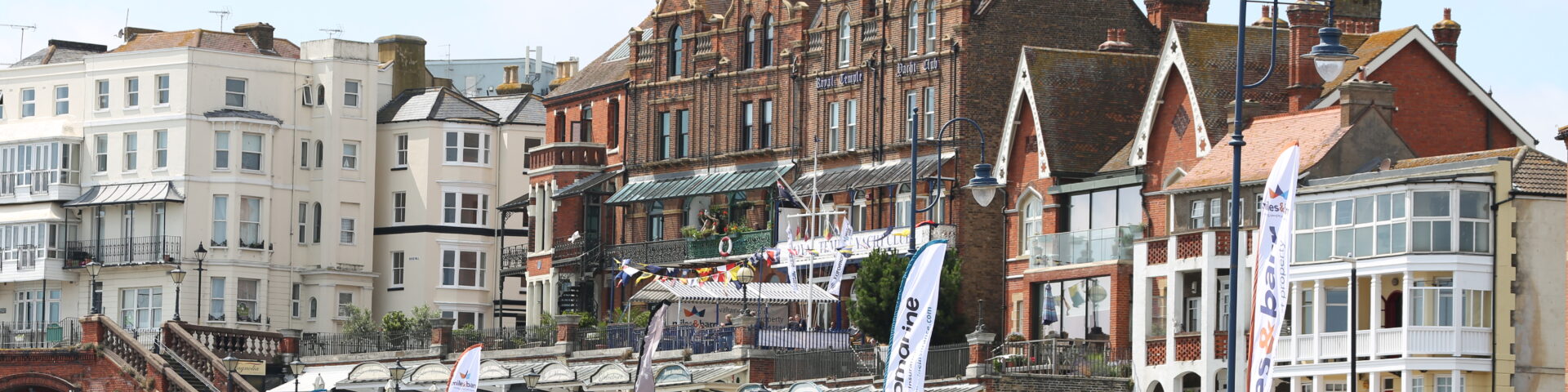
Ramsgate Clubhouse
The Ramsgate Clubhouse was opened in 1896 but London remained the club’s centre of social activity. During this time it was not uncommon for members to hold grand banquets and bohemian concerts in order to raise additional funds for the club.
At the turn of the century 2,000 members dined annually at the Hotel Cecil. The Commodore at that time was Baron De Rothschild who was always accompanied by his close friend The Prince of Wales. The Royal Charter was granted in 1897 and the Admiralty Warrant to wear the Blue Ensign was granted in 1898.
 The club launched an annual Ramsgate Week regatta in 1898 which included a days racing at Deal and Broadstairs. It is not surprising that it took some time to break down the prejudice of the paid hands to racing in the neighbourhood of the Goodwin and Brake Sands, but racers soon discovered that the waters of Ramsgate provided excellent courses for yachts of all sizes.
Caption- Races would start with the yachts at anchor. Cannons would fire blank charges from the Pier Head to alert the paid hands to weigh anchor and hoist sails. This often resulted in a chaotic mess with boats colliding and tangling their rigging. Its not surprising that the Coast Guards had to be kept on hand to fire the cannon and assist the racers.
During the late nineteenth century, Ramsgate Week enjoyed many famous participants. The German Emperor’s schooner “Meteor” raced from Ramsgate until the First World War and King George V’s lovely cutter “Britannia” raced regularly until 1924.
In 1897 the Royal Temple historically challenged and beat the French in their own waters at the Coupe de France. The club famously laid on steamers so that members could follow the racing at Cannes.
During the Wars
During the brief period between the two world wars the big J class schooners had something of a heyday. In 1940 the RTYC clubhouse was requisitioned by the navy and named HMS Fervent, where it became an officers mess and control room for all the various naval activities in the North Foreland area. Unfortunately, after the war things were slow to recover and racing was mainly confined to small days boats such as Essex one designs and Dragons, which frequently crossed the channel to race in Ostend.
During the 1950’s our regatta was known as Kent Yachting Week and by the 1970’s the name had changed to Thanet Week which incorporated dinghy sailing. The dinghy racing eventually declined but with the invention of plastic hulled yachts, our IOR rated fleet expanded and Ramsgate Week was re-launched.
A world-class location
 The Clubhouse commands spectacular views over the Ramsgate Marina, as well as the Royal Harbour. It is also possible to catch glimpses of the Downs, the Goodwin Sands and South Foreland, as well as the French coast on a fine day. The club is situated at the sailing crossroads of Europe and the club boasts a higher number of visiting foreign yachts than any other in the country. The RTYC is well known for its hospitality and visiting yachtsmen are always warmly welcomed by the club as temporary members, and may use all the clubs facilities including accommodation.
Ramsgate is also recognised as a starting point for many record breaking attempts. Steve Fossett, a former Club member, started and finished at Ramsgate when he claimed the Round Britain record in ‘Playstation 2’; he also landed at nearby Manston (Kent International Airport) in his record breaking transatlantic flight. Dame Ellen MacArthur, also a club member, is much associated with the Club and is fondly remembered for allowing her to be raffled as a prize crew during a recent Ramsgate Week. Christian Rattell and his crew aboard ‘Duece Follie’, from Boulogne, were delighted to have Ellen sail with them in the Ramsgate Gold Cup Race.